The Seven
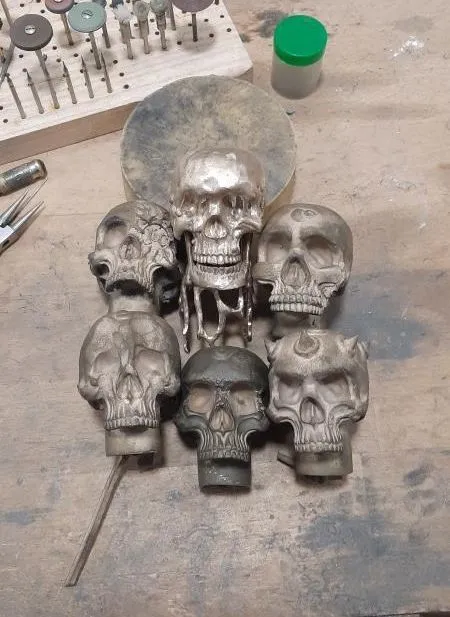
The Seven is a series of seven cat o' nine tails, each associated with a capital sin.
The cat o' nine tails are made from my own hair.
The collection creates tension between two realities: on one side, the historical condemnation of human excesses; on the other, their progressive transformation into monetizable values, now drivers of desire, consumption and performance.

Meaning of the work
The Seven does not treat sins as religious prohibitions, but as persistent structures of human behavior.
Capital sins are no longer condemned. They have been reversed, then justified for economic reasons.
What once consisted of limits to contain is now exploited as a growth lever, relying on cognitive biases and permanent attention capture, at the expense of the long time necessary for introspection, self-questioning and inner construction.
Today:
Pride
becomes radical individualism, dissolving collective responsibility in favor of the self.
Sloth
becomes binge-watching and permanent distraction, neutralizing effort, long time and all personal transformation.
Gluttony
becomes food overconsumption, transforming the body into a field of exploitation and leading to obesity.
Lust
becomes sexual consumption and porn addiction, blurring boundaries and destroying interpersonal relationships.
Envy
becomes constant comparison via social media and advertising, producing frustration, guilt and lasting psychological suffering.
Greed
becomes money accumulation and success indicator, conflating human value with market value.
Wrath
becomes legitimate mode of expression, normalizing violence and fragmenting social bonds.
What once fell within asceticism and inner discipline is now integrated into contemporary discourses—personal development, management, social norms—oriented toward productivist and economic objectives, no longer toward inner peace or elevation of individual consciousness.
The structures are the same. Only the purpose has changed.
What was considered harmful to individual balance is now encouraged. We collectively pay the price.
History
The idea of capital sins was born in the Egyptian deserts in the 4th century, when the first monks, withdrawn from the world, sought to understand what was eating away at them internally.
Among them, Evagrius Ponticus (349–399), who codified what would later be called the psychology of the desert. Drawing inspiration from the Stoics and hermits, he sought to identify the internal mechanisms that disturb the human mind.
He described eight invasive thoughts: gluttony, lust, avarice, vainglory, anger, sadness, acedia and pride. These were not yet moral faults, but internal flaws.
This framework would then be translated, reduced and adapted. In the 6th century, Gregory the Great reduced the list to seven. Later, Thomas Aquinas established their status: not acts, but fundamental inclinations, capable of generating all other behaviors.
The Church seized upon them. Art represented them—notably in the work of Hieronymus Bosch. The list became a moral pillar, then a lasting cultural framework of the West.
Credits
Manche en bois
Wooden handle: Anonymous Blacksmith - Cutler